| |
Operational Amplifiers
The "Op Amp" is one of the most valuable and versatile integrated circuits
to ever come down-the-pike. If you want to spend a Month -of-Sundays abusing
yourself, and you've run out of sharp sticks: build an Op Amp, from scratch--one
that works as well as the monolithic version; or for that matter, one that
works period! There is almost no circuit design that can't benefit from
the use of the Op Amp.
From the 741--the first internally compensated Op Amp, and son of the
709--to the super-fast near GHz Op Amps; these little "boogers" are easy
to use: If you bypass, decouple, and use common sense... Ha! There
I said it. Ha!
"How does this Damn thing work?" "Very well thank you."
Lets keep this simple: The Op Amp is basically three amplifiers or
stages. The input differential stage; the gain stage, and the output stage.
The differential stage is the heart of the Op Amp, and the most confusing.
If you think of the Op Amp as a differential amplifier --because that's
what it is--and think of the other stages as parts of the same, then the
confusion may drop about 20dB, or go up thirty.
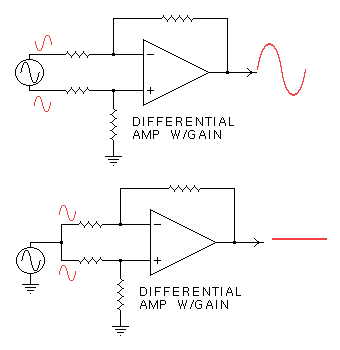
The Op Amp is a current device in, and a voltage device out. The Op
Amp's output is not dependent on the amplitude of the input signal per
se, but on the difference between the input pins. If you tied both pins
together and applied a very large signal to this connection: the output
would be nothing, or at most, a weak crappy replica of the input. This
is also known as common mode rejection, (CMR).
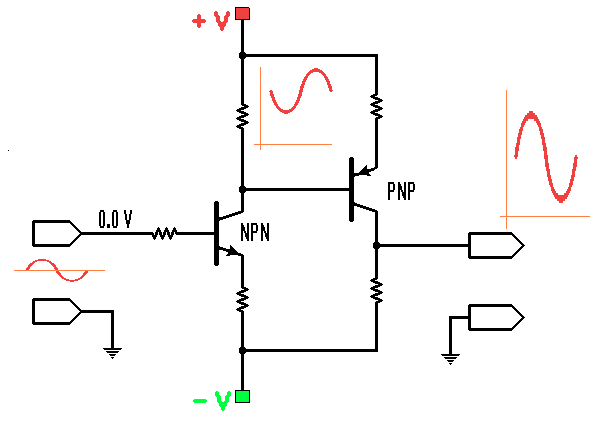
If you've ever designed a DC (direct coupled) amplifier with more than
two stages, you've discovered the stair-step phenomena: as each collector
is connected to the base of the succeeding stage, the higher the emitter/base
bias or offset must be. Of course that's why God made PNP transistors (we
finally know the reason), but this can be taxing and not always satisfactory.
Enter the Op Amp: it has the facility of not having--by nature--any offset
between input and output. You could DC couple zillions of OP Amps in cascade.
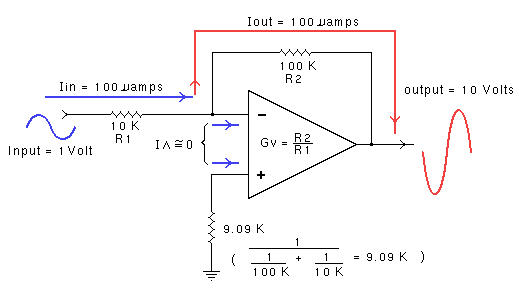
When configured as an inverting amplifier with some gain (Gv), its sole
aim in life is to not allow any current to flow in the inverting pin. And,
because it has in its arsenal, gains on the order of several hundreds of
thousands (100k to 600k), it has no problem in doing just that: No Current
In! Remember: it is a current input, and a voltage output device.
|
|
| |
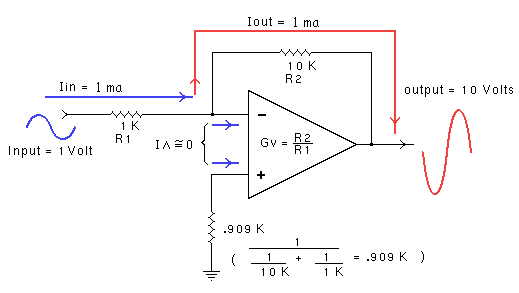
Anyway, because of the aforementioned (I've always wanted to use that
word in a sentence), let's say a current of 1 milliamp is caused to flow
to the inverting input pin through the 1000 ohm input resistor, R1, the
Op Amp tries to maintain equilibrium, i.e., no current flow in that input
pin. To do this marvelous feat, it generates an output voltage of the opposite
polarity, which causes a current, of equal but opposite polarity, to flow
through the 10 K feedback resistor, R2. Because the feedback resistor is
ten times the value of the input resistor, it will require ten times the
voltage to cause that same 1 ma to flow. The view from the input pin: there
is a current of 1 milliamp coming down the input resistor, and at the same
time, there is a current of 1 milliamp--but opposite polarity--coming from
the feedback resistor. When they arrive they cancel (null) each other,
and there is no current left over for the input pin; therefore satisfying
the zero current requirement of the Op Amp. "Eurika!" you have a signal
ten times larger, than you started with, and boys and girls, there's not
a mirror in sight! |
|
| |
OK. OK. If you're so smart: what the Hell is Virtual Ground
? Explain that if you can! I just did! Because no matter (within reason)
how much current was made to flow in the input resistor, no voltage change
was seen at the other end--the input pin. If the resistor had been attached
to ground, the effect would have been the same: current flow into the resistor;
no voltage at the other end. I know it sounds silly, but hang on for one
more point. Let us say you use a CMOS Op Amp having an input impedance
of tens of thousands of megohms--with the same resistor values as the example
above. You apply a signal generator that has a output impedance of 1000
ohms. We know that if we apply that generator to a 1000 ohm load, the output
voltage of the generator will drop by 6dB (50%). Now apply this generator
to our CMOS Op Amp and measure the generator output level before and after:
the output will be down by--you guessed it--6dB. In fact, nothing has changed,
whether its a CMOS or a BJT Op Amp, the principle is the same: if the Op
Amp has enough gain, the device itself has no discernible effect on the
circuit.
Now! The non-inverting input is another story altogether!
Its input impedance is affected by the device type. In the CMOS case the
non-inverting input pin--as mentioned earlier--has the impedances approaching
tens of thousands of megohms. This high impedance input can be used to
great advantage: in sample & hold circuits, peak detectors--you name
it.
|
|