Borrowed From [1]
the University of Washington,
Electrical Engineering Dept.,
[1]
Excellent Senior work that was the subject of our LINK TO UW; which was
subsequently dropped by them.
From Doppler Shift to Off Axis
Movement
Final Report: "Where is the Doppler Shift?"
by Nathan Horton
Andrew Lundberg
EE 488
Winter 1996
Introduction:
The purpose of our project was to investigate the theory and workings
of the past optical microphone projects. From the outset, we believed that
the succuss of past projects could not be attributed to Doppler Shift,
as was reported.
Where is the Doppler Shift? was an appropriate question that proved
to be somewhat rhetorical. Much was learned and hypothesized during our
investigation. The importance and resulting foundation for our project
was the substantiation of our theory that the optical microphone described
in the past should not work for the reasons presented. The following will
detail our final setup, method, observations, analysis, and conclusions.
Setup:
The majority of our research centered around two different setups:
The first was a traditional Michaelson Interferometer (Figure 1a). This
was setup with two fixed mirrors, a beam splitter, a beam expander, a photo-detector
and a 1mW HeNe laser. The photo-detector was fed into a pre-amp box and
then out to a spectrum analyzer. The system was driven by a speaker with
an amplifier connected to a signal generator. An audio microphone was used
as a reference and was placed near the speaker.
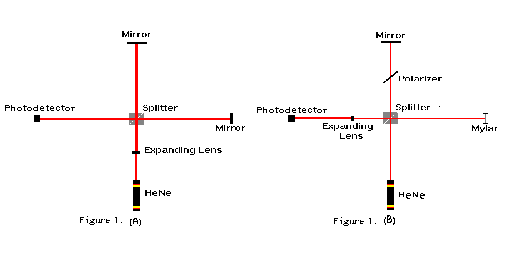
The second setup was almost identical to the first (Figure 1b).
The only difference was the substitution of a 2 in. diameter mylar diaphragm
for one of the fixed mirrors. A polarizer was also used on the reference
beam to help equal out the relative intensities.
Revised parts list:
-
1 Laser (1mW)
-
1 Polarizing Beam Splitter
-
1 Beam Expander
-
2 Front Surface Flat Mirrors
-
1 Mylar Diaphragm and Mount
-
1 Photo-detector (Newport 815)
-
1 Photodiode (photo-detector)
-
1 Audio Microphone
-
1 Speaker
-
1 Amplifier
-
1 Function Generator
-
1 Spectrum Analyzer
-
1 Polarizer
-
1 Headphones
Method:
The general approach used was the analyzing of the Michaelson Interferometer
setup. As stated above, we ran two sets of tests; one with a second mirror
placed at the test arm and one with a round, mylar diaphragm placed at
the test arm. For most of our testing, we used the microphone to obtain
a reference signal.
For the two mirror setup, we placed the expanding lens between
the laser and the beam splitter to produce a clear, circular fringe pattern
at the photo-detector. We drove the mirror at the test arm with the speaker
and analyzed the frequency response. According to our hypothesis about
the Doppler effect's lack of responsibility for the results that were expected,
we attempted to run experiments that would show what was responsible. We
analyzed the spectrum response with the photodiode at two different spots
in the airy pattern. First at the very center and then out on the edge
fringes. A photodiode was used to vary the number of fringes that would
be read. We ran experiments displaying many fringes, a few fringes, and
a single fringe in the photo-detector area (the photodiode enabled us to
get a few and single fringe coverage of the detector area).
To run our second set of tests, we replaced the second mirror
at the test arm with the mylar diaphragm. For this setup we placed the
expanding lens between the beam splitter and the photo-detector so that
the reflection off of the mylar would be a point instead of a large spot.
We also placed a polarizer between the reference mirror and the beam splitter
to equalize the intensity of the reference beam. With this setup the fringes
appeared straight, so we didn't move the location of the photo-detector
in the pattern as done previously. However, we did drive the diaphragm
with the speaker and use the photodiode to obtain the different number
of fringes across the area of the photo-detector as done with the first
setup. We obtained variation on this setup almost by accident. One of us
ran the laser test while the other cleaned the reference mirror and got
a working setup. Further testing with this `one arm' setup was done and
results due to "off axis movement" were obtained. Finally, we ran the photo-detector
into the speaker and drove the diaphragm with our voice to produce a microphone.
Observations:
Michaelson two mirror setup:
-
must be driven very hard
-
poor signal results (Figure 2)
-
no signal if one arm is blocked (Figure 3)
-
lots of noise
-
aperture effects
-
many fringes (Figure 2) and one fringe (Figure 4)
-
signal better at center of pattern
-
weaker on edge (Figure 5)
-
several fringes
-
harmonic addition
-
minimal amplitude control
-
no frequency shifting with increase in volume
-
direct correlation to test frequency
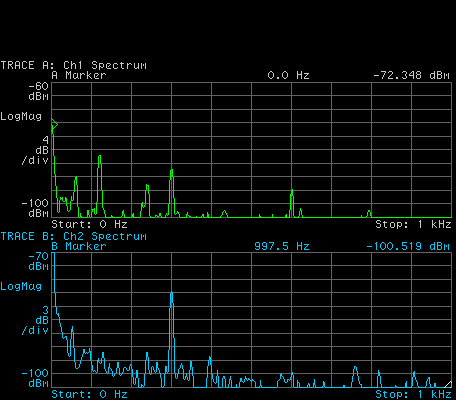
Figure 2. (Top) Response from middle of airy pattern setup (a).
(Bottom) Reference signal from microphone.
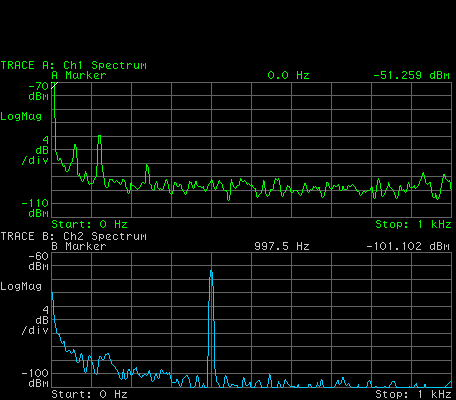
Figure 3. (Top) Response from setup (a) with no reference arm.
(Bottom) Reference signal from microphone.
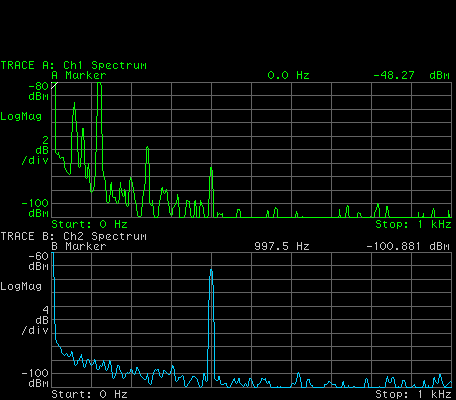
Figure 4. (Top) Response for single fringe measurement. (Bottom)
Reference signal from microphone.
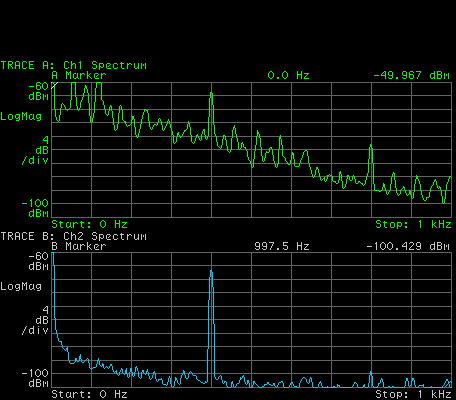
Figure 5. (Top) Response from edge of airy pattern setup (a).
(Bottom) Reference signal from microphone.
Michaelson with one reference mirror and one mylar diaphragm
-
good signal (Figure 6)
-
very sensitive (better than microphone)
-
good amplitude control (Figure 6 and 7)
-
works best when slightly missaligned
-
limited high frequency response
-
two inch mylar diaphragm 5 kHz
-
mylar directly on speaker 10 kHz
-
lots of harmonic addition (increases with volume) (Figure 8)
-
least noise when reference beam at minimum intensity
-
no bands, all frequency spikes
-
direct correlation to test frequency
-
no frequency shift with increase in volume
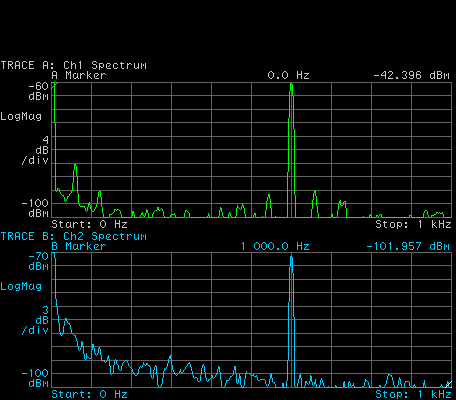
Figure 6. (Top) Response for measurement setup (b). (Bottom) Reference
signal from microphone.
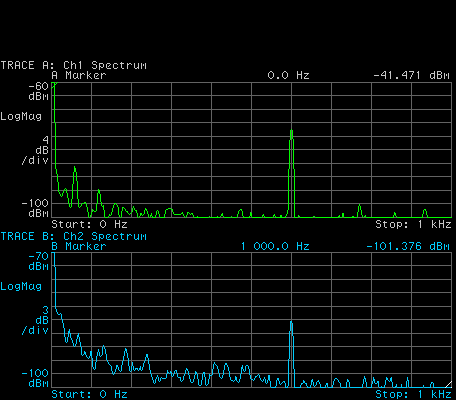
Figure 7. (Top) Response for reduced amplitude from figure 6.
(Bottom) Reference signal from microphone.
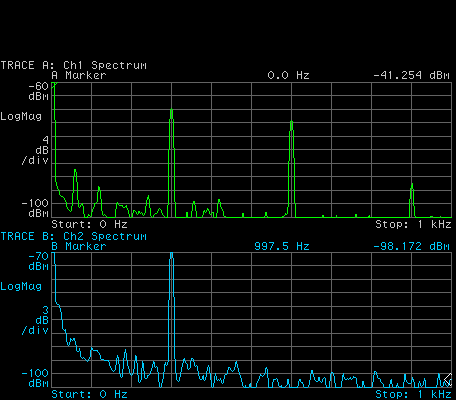
Figure 8. (Top) Response for setup (b) driven to show increase
in harmonics. (Bottom) Reference signal from microphone.
Off axis movement (one arm results)
-
no signal when spot is centered in detector
-
best signal if spot is placed directly on the edge of the detector
Analysis:
Doppler Shift
The Doppler Shift has been accredited as the reason for the frequency
correlation in laser microphones in the past. However, our understanding
of the Doppler Shift gives it some very particular properties that will
make it identifiable. The main property and the one that most clearly contradicts
past claims is the increase and decrease of Doppler frequency due to increase
and decrease in volume. In effect this means that a frequency spike in
the frequency domain would shift up and down in frequency when the amplitude
of the test signal is increased. Nowhere in our experiment was this behavior
recognized. The other possible sign that Doppler is at play would be found
in frequency bands that increase and decrease in width (Doppler Shift riding
on another effect). Although frequency bands were found at higher frequencies
this behavior was not present either. We have attributed the existence
of the bands to diaphragm characteristics.
Optical Path Length
Our original theory on the past success of optical microphones was
based on the effect of phase shifting due to change in optical path length
of one arm in relation to the other. This phase shifting causes the fringes
in the interference pattern to run back and forth due to the movement on
the mirror. However, the exact reason for an output signal was not apparent
at first. The first setup allowed us to isolate this effect. We know that
it was an interference phenomenon, because if one arm was removed then
the output signal went away.
From our findings we have come to the following hypothesis as to the
reason for the correlation between the change in optical path length and
the output signal seen on the spectrum analyzer. There are two approaches
that lead to the same result.
The first is an effect of isolating a single fringe over the photo-detector.
This gives rise to a possible intensity differential of a dark fringe compared
to a light fringe. As the fringes run back and forth across the detector
the intensity changes up and down with each passing fringe. The movement
of the fringes is proportional to the movement of the diaphragm. The period
of this movement is the frequency (Figure 9).
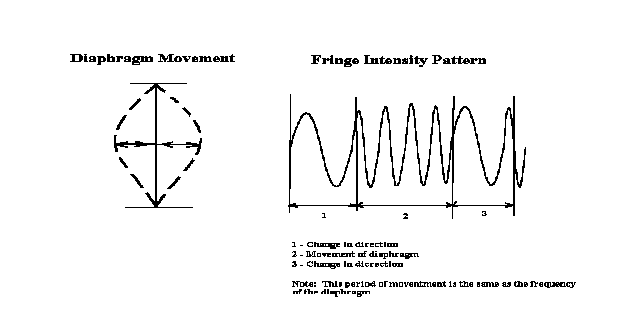
Figure 9. Relationship between diaphram movement and fringe
movement.
Each intensity peak is a fringe and as they are moving they are close
together and when they are changing direction the fringes are spread out.
This creates an envelope frequency on the signal that is the same as the
frequency of the input signal.
The second approach is one of considering many fringes over the
surface of a photo-detector. Our explanation of this effect is based on
the following assumption. As a fringe moves, its intensity changes non-linearly
(sinc distribution) as shown in Figure 10.
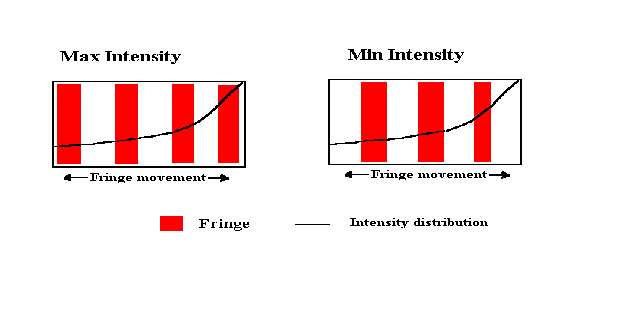
Figure 10. Non linear change of intensity between fringes.
If this is true then the difference of intensity over the diaphragm
ranges from some minimum to some maximum. These minimum and maximum intensities
are a result of different fringe placement over the area of the detector.
This intensity distribution explains the findings of better response at
the center of the airy patter than at the edges, since the center is the
least linear portion. This gives rise to a bigger intensity difference.
The extraction of the signal is the same as describe for the single fringe
above.
One interesting side note was realized when trying to read a signal
from a couple of fringes. No output was found for this setup. To explain
this we make the assumption that the difference between just two fringes
is not large enough to differentiate it from the noise.
Off Axis Movement
Off axis movement of the diaphragm was not some thing that we anticipated.
However, it proved to be the best way to reproduce the test signal. This
effect is easily differentiated from the change in optical path length
by removing the reference arm. This will actually improve the response
of the off axis movement by eliminating the effects of interference (OPL).
Off axis movement is due to the fact that the diaphragm does not move with
a flat front. This causes the reflection angle of the beam to change slightly.
The result is that the beam partially moves in and out of the photo-detector
area (Figure 11), thus varying the intensity directly proportional the
frequency of the
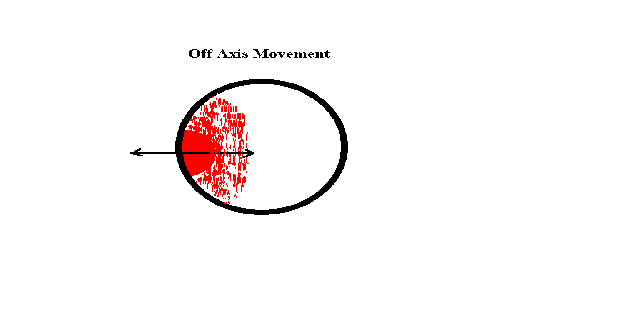
Figure 11. Off axis movement causing intensity difference on photo-detector.
diaphragm. Off axis movement explains why this setup with the reference
arm gave better results when slightly missaligned. This allows the place
of highest intensity to move in and out of the detector area. Good amplitude
control is found here too, due to the fact that the larger the signal,
the more the diaphragm bows and moves the beam in or out of the photo-detector.
It is easy to see that this effect is not present when a flat mirror is
used at the test arm as in the first setup.
Conclusion:
The Doppler Effect was never found, and to our knowledge, it has never
been found in this manner. We believe it is there, but that it is buried
in the noise and would require extensive signal processing to separate.
The change in optical path length is the dominant interference effect and
can be partially attributed to the success of the past optical microphone.
Increased use of signal processing could greatly improve the performance
of the optical microphone due to changes in the optical path length. However,
if we were to build an optical microphone, we would utilize the result
from off-axis movement theory because it gave us our clearest signal reproduction.
DISCLAIMER:
Borrowed Work product of U of W EE department.
Excellent Senior work that was
the subject of our LINK TO UW; which was subsequently dropped by them.
Copyright
Comments or Questions about this site
|