© Copyright
Questions or Comments: .
Stealthy
Ships
Improving Ship Stealth
using Sea Water Curtain
|
| ------Main
Page---Details,
Technology---Links---FAQs---Glossary---- |
SUMMARY
Proposed is a technology (AWCT) for adding Stealth properties
to existing U.S. Fleet surface ships by the use of sprayed sea water.
The Adaptive Water Curtain Technology (AWCT) is intended to deflect
and scatter enemy radar waves thus reducing the ships radar cross section
(RCS). It consists of (highly conductive) sea water sprayed in a fashion
that effectively creates an angled radar reflective curtain around the
ship.
To reduce the ships remaining RCS, the water curtain can be
"modulated"
such that the returns appear as "Sea Clutter." This could be done by determining
the surrounding Sea State--either locally, or from satellite Sea State
data, i.e., deriving the Sea Clutter Spectrum; and applying the appropriate
coefficients to the modulating process for optimum mimicry.
This approach is suggested as an "Add-On" to existing surface
ships, an interim measure until the next generation DD(X)
of stealthy surface ships has replaced this class. The Arleigh Burke class
Destroyer--which has rudimentary stealth technology, is used as an example
of a recipient ship for this technology. Although this class of ship has
a reduced RCS over its predecessor, it can still benefit significantly
from the proposed technology.
This technology can reduce a surface ship's vulerability to Radar
cross-section (RCS), Infrared signature (IR), and Visual signature
reduction
This is a Work in Progress.
There are fundimental questions yet to be answered. See
List
|
|
|
-
|
|
FEATURES:
1)_ Reduced RCS.
2)_ IR Signature Mitigation of Ship Stacks by the use of "Pre-Cooled"
Water Curtain.
3)_ Reduced Visual Signature (Camouflage).
4)_ Possible EMP Protection. more
5)_ System able to mimic Sea Clutter.
6)_ Water streams can be "Modulated" for enhanced concealment.
7)_ Uses Fire Fighting Technology.
8)_ Compensation for finite Water Stream boundaries (gaps),
using Spray and Misting.
9)_ System uses Feedback for accurate positioning of Water
Stream "Landing zone."
10)_ Able to (actively) Resist Wind Loading on Water Curtain.
11)_ Can Selectively open Gaps in Water Curtain for Radar, IR, Communications,
etc.
12)_ Satellite (or RPV) for Interactive Sensing and Alignment for
Stealth Optimization.
13)_ System Cleaning by Periodic Flushing with brackish or clean
water.
|
|
.
 |
-The
Sea Shadow, Stealthy Ship Testbed-

-Sea
Shadow, sporting 45º angle Faceted, Radar Reflecting/Absorbing, Hull-
|
| |
-USS
Zumwalt (DD-21)-

DD(X) Class Stealthy Multimission Destroyer,
----------construction
starting in 2005; comissioning expected ~ 2008---
|
|
.
|
-Radar
Evasion by Shaped Water Curtain-

----------Full Water Curtain---------------DDG-67-------------Stepped/Folded
(Fresnel lens)
|
| The Adaptive Water Curtain Technology (AWCT) is intended to
deflect and scatter enemy radar waves thus reducing the ships radar cross
section (RCS). It consists of highly conductive sea water sprayed in a
fashion that effectively creates an angled radar reflective curtain around
the ship. |
|
|
.
|
-Fire Fighting
Technology used in AWCT-
Fire Boat projects high pressure water streams hundreds of feet into
the air
using powerful Diesel water pumps feeding steerable nozzles called
Monitors.-
|
|
.
|
| |
-Active
Water Curtain Technology-

Array of Powerful Water Pump outlets creating Water Curtain-
|
|
.
|
|
-Water Curtain
Modulation-
|

|
|
Nozzle Control for 'Sea State' Mimicry
|
|
| To reduce the ships remaining RCS, the water curtain can be
"modulated" such that the returns appear as "Sea Clutter." This is done
by determining the surrounding Sea State--either locally, or from satellite
Sea State data, i.e., deriving the Sea Clutter Spectrum and applying the
appropriate coefficients to the modulating process for optimum mimicry. |
|
|
.
|
-Directable
Fire Fighting Water Jet known as a "Monitor"-

Note Hydraulic Actuators for Automated Controls, including
Azimuth, Elevation, Pressure, Spread, Modulation, etc.-
|
|
.
|
-10,000
GPM Water Pump-
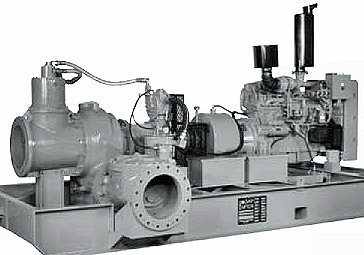
One Aegis Class Cruiser would require ~ 20 such
pumps for approximately 200,000 GPM water flow-
|
|
.
|
-Arleigh
Burke DDG-51 using some Shaped Water Curtains-

Click image for larger version
188 kB-
|
|
.
|
|
-Tweaking
for Optimum Stealth, using Satellite or UAV-
|
 |
|
Optimizing Mimicry, Interactively-
|
| Satellite Sea State Data could either be taken from the NOAA
database, or for better accuracy, certain DoD satellites could be
tasked to directly observe the ships unique signature in real-time,
while interactively tweaking for optimum stealth. There could also be
a locally launched UAV to do this same interactive alignment. |
|
|
.
|
-Idealized
Examples: AWCT Hiding All, including Superstructure-
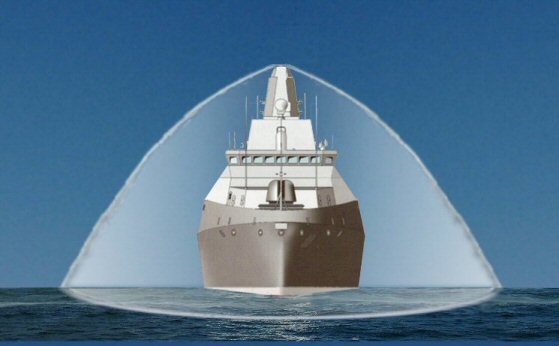
Water Pressure and Nozzle Angle Shape and Control Coverage,
Note: this type of coverage also helps Mask the Stacks' IR Signature
-
|
|
.
|
-Without
AWCT, 7° Roll Exposes Starboard Side to Radar-
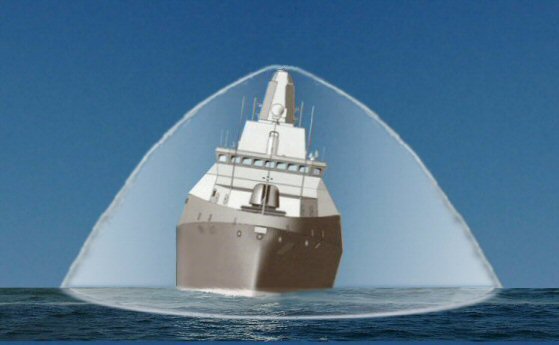
AWCT Holds Form despite Roll-
|
|
.
|
-Active
Windowing,
Rapid Modulation of Pump Nozzles-

Creating Dynamic Openings in the Water Curtain
Useful when synchronized with Radar and other Sensors
-
|
|
.
|
-Adaptive
Selective Opening of AWCT,
"Peeking Out"-
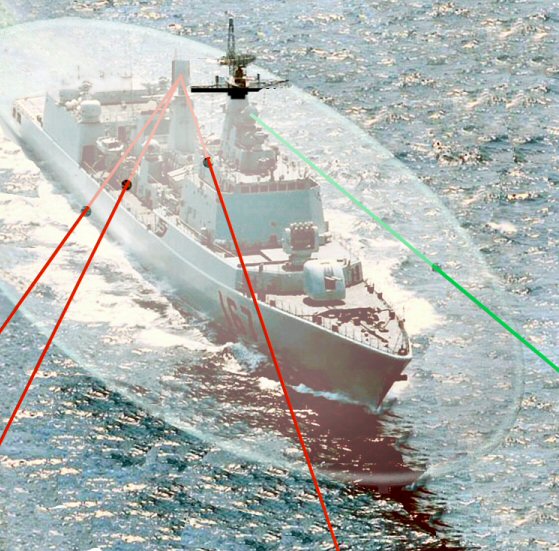
Synchronized Openings for Radar, Sensors, etc
-
|
|
.
|
-EMP
Defense?-
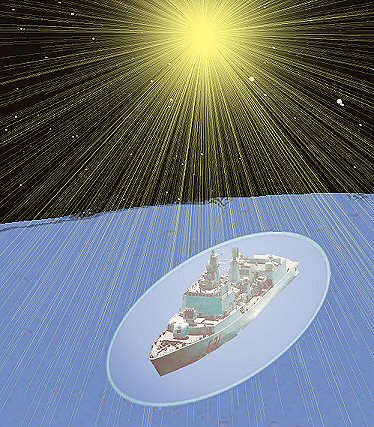
Conductive Sea Water Shunts EMP currents to 'Ground'
Super Saturated Salt Water added for enhanced conductivity
More
on EMP -
|
|
.
|
-Water Inlet-
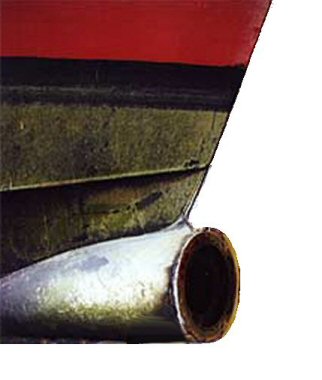
Water Inlet at Bow for "Ram Boost"-
|
|
.
|
|
-Water Inlet-
|
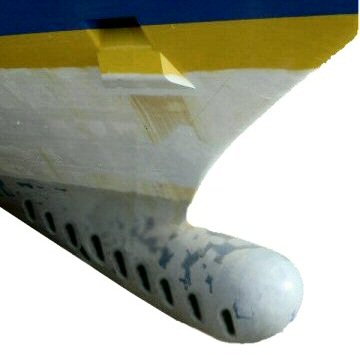
Water Inlet incorporated into new ""-
|
|
.
|
| ------Main
Page---Details,
Technology---Links---FAQs---- |
| Partial List of Anti-Ship Cruise
Missiles (ASCM) |
USA
AGM-84 Harpoon / Harpoon Block II
France
Exocet AM39 / SM39 / MM40 / BC40
AS 15 TT
India/Russia
Brahmos (PJ10)
Russia
SS-N-27 Klub
SS-N-25 Switchblade
SS-N-22 Sunburn
SS-N-19 Shipwreck
China
C-701
Germany
AS.34 Kormoran 1/2 |
EU
Polyphem
Norway
Penguin
NSM
Britain
Sea Skua
Sweden
RBS 15 Mk3
Italy
Otomat Mk2
Israel
Gabriel III
|
. |
LINKS:
Anti-Ship
Cruise Missiles
|
|
.
|
-FAQ-
| 1)_ Q... What
makes water able to fend off RADAR detection? IR
Detection?
A...
Water,
especially sea water, is highly electrically conductive and if the water
droplets are compact enough, RADAR waves will be reflected just as if the
surface were metal. Also, streams of sea water will absorb as well
scatter radar energy.
...
Heat
from the stacks, etc., can be obscured from IR Detection by sufficiently
thick Pre-Cooled water blanket.
2)_ Q....
What
is Sea Clutter?
A...
Radar
backscatter from an ocean surface is commonly referred to as Sea Clutter.
Any radar backscatter not due to the scattering from
an ocean surface constitutes a potential target.
3)_ Q....
Wont
enemy RADARs with MTI detect the water curtains motion?
A...
The
water curtain is a surface of fast moving water droplets forming random
patterns and movements mimicking the surface motion of the sea water surrounding
the ship--Sea Clutter. See
2)_
4)_ Q....
In
addition to RADAR, IR, INS, GPS, Terminal Guidance, etc., Anti-Ship
Missiles (ASM) uses a Radio Altimeter which will maintain it at about
3 meters above wave tops; so, once launched toward the ship, whats to
prevent the missile from "blindly" slamming into the side of the ship?
A...
If
the ASM is launched close in, and the target ship does not move out of
the way, the missile will either detonate upon contact, or resort to "salvage
fusing" (Salvage Detonation).
5)_ Q....
If
the water intake is at the bow, taking in thousands of GPM, how
will that effect the ship?
A...
It
may relieve the bow wave pressure which would improve speed and range;
or NOT.
6)_ Q....
What
happens when the wind blows the water curtain?
A...The
system is adaptive, that is, it monitors each water stream landing zone,
and by adjusting the appropriate nozzle/monitor/pump combination (including
azimuth, elevation, water pressure, spread, modulation, pulsing,
etc.), compensates for wind speed and direction (wind loading).
7)_ Q....
How
does it know where the water stream landing zone is?
A...
Each
nozzle is electrically isolated such that a multiplexed low frequency signal
is applied to the water stream (via the nozzle); at the water stream landing
zones there are arrays of antennas that "look" for the temporal electrical
signal. The antennas are spatially sensitive allowing for water stream
error detection and correction.
6)_ Q....
How
will the corrections be made?
A...
The
nozzle/monitor/pump combination allows just about any correction to the
water streams.
7)_ Q....
Will
the water curtain need to be active all the time?
A...
Probably
not, during obvious threats and times of uncertainly it might be fully
active; otherwise, the more vulnerable (large RCS) areas of the ship might
be active 24/7.
8)_ Q....
What
damage--if
any--will result of spraying sea water on the ships outside?
A...
It
isn't clear if this extra salt water will add to the maintenance of the
vessel; however, the use of Fresh Water could be used, periodically (e.g.,
at shut down), to wash-down the affected areas.
9)_ Q....
Wont
the water curtain block or interfere with the ships Radars, radios,
sensors, etc.?
A...
It
could, however, any and all EW operations with the "outside world" would
be coordinated with the AWCT. see peeking
out
10)_ Q....
How
can the water curtain "peek holes" be synchronized with all of operating
EW equipment?
A...
See
9)_
above.
11)_ Q....
What
will be the impact of running pumps, falling (spent) water, etc., on the
ships sonar siginature?
A...
That
is a question yet to be answered.
12)_ Q....
Are
there "angles-on-the-ship" that are more vulnerable to detection
than others, e.g., like the bow?
A...
Depending
on the ship's speed and the relative wind direction, etc., the bow could
be the most vulnerable. Of course, during a storm the sea state will aid
the ship in its stealth.
13)_ Q.... What
is "Radar Cross Section"?
A...
The
radar cross section (RCS) of a target is the projected area that would
intercept the transmitted signal and reflect isotropically an amount that
produces the returned signal at the receiver. In other words, radar cross
section provides an indication of how well a given target reflects radar
energy.
13)_ Q....
What
is "Bragg Scattering"?
A...
Bragg
Scattering is the enhanced backscatter due to coherent combinations of
signals reflected from a rough [sea] surface having features, with periodic
distribution in the direction of wave propagation, and whose spacing is
equal to half of the wavelength of the incident radar waves as projected
onto the surface. This is most easily detected by HF radar.
|
|
|
.
|
Fundamental questions to be answered:
1)_ Wind Effects: wind loading on solid stream, tables, and/or plots.
2)_ Radar properties of sea water, solid stream, breaking stream, spray,
misting: absorption, scattering, refraction, and reflection.
3)_ The effect of 'pre-cooled' water curtain on IR signature of exhaust
stacks.
4)_ Effect of falling water (from water curtain) on ship's acoustic
signature.
5)_ Maximum (GPM) amount of water required for optimum effectiveness.
6)_ Features required for optimum mimicry of local sea state, i.e.,
boundary between water curtain and sea surface.. |
|
|
.
|
misc notes:
false-alarm rates
With these ideas in mind, it is not surprising
that the physical area of a target is normally greater than the radar cross
section because some the incident energy is scattered and absorbed by the
target. Use of radar absorbent material (RAM) and specific shapes and angles
helps to minimise the radar cross section. Target aspect also changes the
radar cross section markedly and needs to be allowed for in the design
of a radar system. Radar designers normally use extremely pessimistic (low)
values for radar cross section during radar design and performance calculations
to ensure their systems meet minimum requirements when introduced into
service.
The radar cross section
of a target is not constant with operating frequency. There are three broad
areas of interest with respect to physical target size, operating frequency
and resulting radar cross section. These areas are:
Proposed is a technology for adding Stealth properties
to existing U.S. Fleet surface ships by using an "Active Curtain" of conductive
sea water.
The Adaptive Water Curtain creates Virtual Faceted
Surfaces.
One of the greatest threats to surface ships is
the sea-skimming Anti-Ship Cruise Missile (ASCM), which is a "fire and
forget" supersonic radar guided missile; Exocet and Harpoon being the better
known.
To combat this threat, Stealth Technology is being
incorporated in the newer ship designs.
The Active Water Curtain Technology (AWCT)
is meant for use on existing ships not already having stealth qualities;
as well as an adjunct to existing stealthy ships.
My motivation for researching and creating this
web page on this subject is the same as for my page: a wish
to contribute to the 'common defense' of this great nation.
.
© Copyright
Questions or Comments: -
|
|


