| A
"Check-List" for Measurements is as Follows:
1..
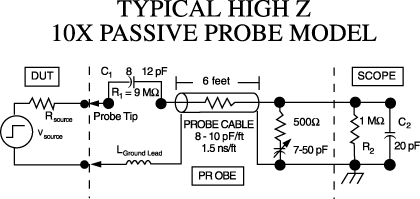
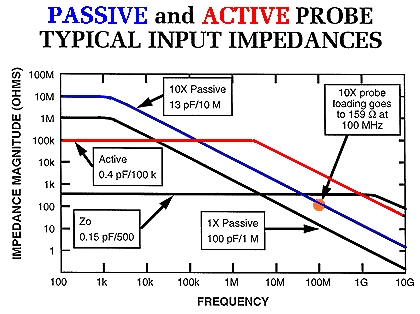
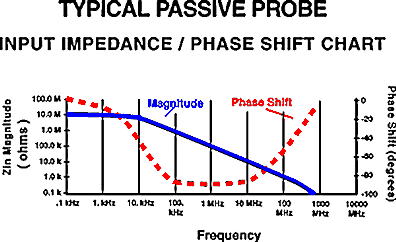
Always use "10 X" probes: they load the DUT (device-under-test) ~ 10 Meg
ohms @ ~ 10 pfd. A "1 X" probe offers 1 Meg ohm @ ~ 50 pfd. The designation
"10 X" refers to the attenuation of the signal by the probe (not gain).
In order to attain such light loading by the scope--while maintaining bandwidth--this
tradeoff is required.
2..
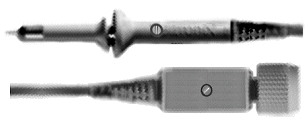
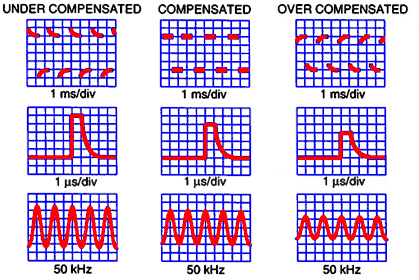
Make sure the probes are compensated
(adjust trimmer at connector housing) if attaching them to a different
scope. This ensures maximum fidelity and bandwidth of the signals being
eyeballed.
3..
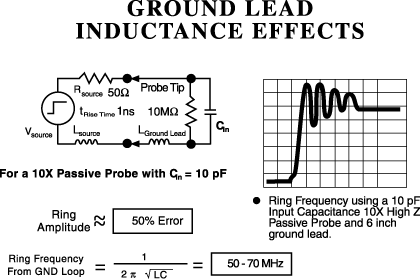
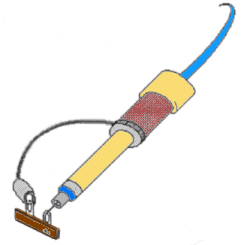
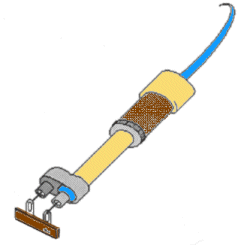
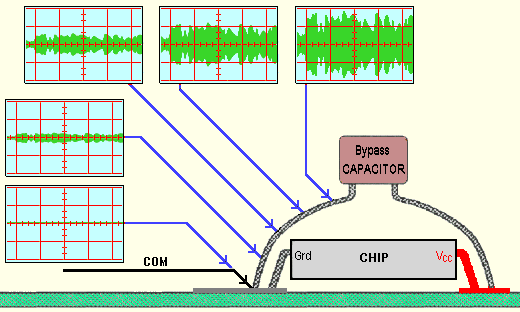
Use the shortest ground lead or clip-lead possible: the shorter the better!
Excessive ground lead length introduces unnecessary inductance and can
alter the displayed signal, as well as reducing the scope's effective bandwidth
(acts like a lowpass filter).
4..
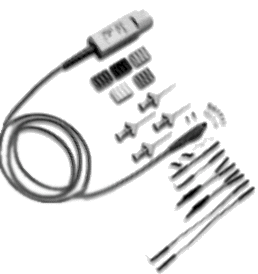
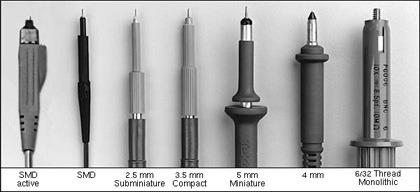
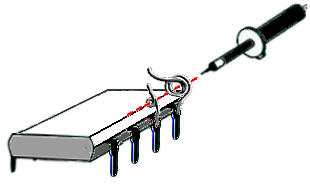
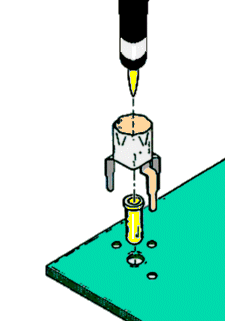
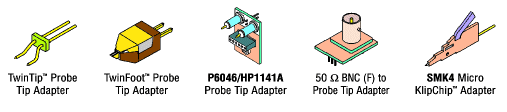
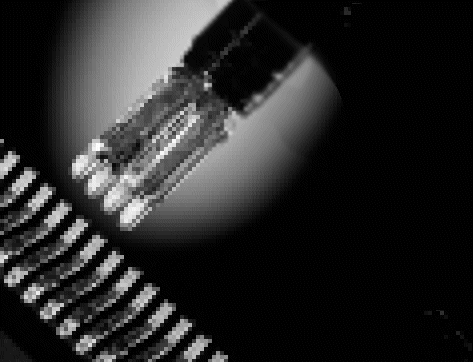
When Measuring very high frequencies--especially in tight spaces--consider
using a RF probe (see figure).
Also, there are--so-called--FET or active probes, which are non-loading
(almost) wideband probes with built-in amplifiers.
5..
When buying probes for your oscilloscope, make sure the probe is of sufficient
bandwidth for your particular scope: the probe is the first-order bandwidth
determinant of any scope.
Some
scopes have such a wide bandwidth, that no passive probe is able to do
it justice, and the only way to use the maximum bandwidth of this type
of scope is to drive the scope from a 50 ohm source through a 50 ohm coax,
terminated into 50 ohms at the scope's input. In fact, some high performance
scopes have a 1Meg ohm/50 ohm termination switch for just such occasions.
|